26/05/2026
It’s no secret that AI infrastructure is scaling fast. In 2025, total operational data centre capacity exceeded 40GW across 97 markets - a figure largely driven by hyperscalers, enterprise, data centre operators, and a growing number of AI-focused providers entering the market.
As AI-driven demand increases, one task emerges at the top of the priority list: expanding compute capacity to support large and complex AI workloads. And to deliver that compute capacity at scale, organisations need to first build and expand physical data centres.
Whilst that expansion might seem straightforward, it’s constrained by four critical infrastructure fundamentals: land, power, cooling, and connectivity. If any of these are miscalculated, they quickly become bottlenecks that slow deployment, increase costs, and limit long-term scalability.
The 4 Planning Fundamentals of AI Data Centres
These four resources have become central to successful AI data centre expansion:
- Land - AI infrastructure needs sites that can support current and future growth. The main considerations should include sufficient space for expansion, disaster-resilient locations, and local zoning and regulatory approvals.
- Power - High-density AI environments also depend on reliable, scalable energy access. This should look like grid capacity and stability, the availability of backup power, and renewable energy integration.
- Cooling - Since GPU-heavy workloads generate significant heat, advanced cooling infrastructure is key to successful resource planning. Environments should be cool and dry, with reliable access to water and support for liquid-cooling technologies.
- Connectivity - Without proper network infrastructure, AI services are unable to scale efficiently. Key considerations should include high-bandwidth capacity and low-latency data transmission between compute clusters.
Why Connectivity is Often the Hidden AI Bottleneck
When it comes to planning AI data centres, connectivity is often pushed down the priority list. The truth is, it’s connectivity that determines whether AI infrastructure is able to scale efficiently over time.
There are four critical connectivity elements that organisations need to balance to future-proof AI investments:
- Proximity - Building infrastructure near major long-haul fibre routes and interconnection hubs improves performance and simplifies expansion.
- Capacity - AI workloads need resilient, high-density fibre infrastructure that is able to scale bandwidth demands over time.
- Latency - Efficient network topology with fewer intermediate nodes helps minimise delays - especially for real-time AI applications.
- Scalability - Modular architectures and AI-driven automation help networks adapt to evolving traffic demands and future growth.
AI Training vs. Inference: How Do Network Demands Differ?
During the planning stage, it’s important to consider the different types of AI services and network options to support them. Training and inference workloads impact networks very differently.
Training workloads are less latency-sensitive and more dependent on massive compute capacity and high bandwidth. Large datasets moving between GPUs and storage environments place heavy strain on network resources.
On the other hand, inference workloads push traffic closer to the network edge - albeit, this is a sliding scale. Text, images, and videos usually aren’t latency-sensitive, but video and multimodal use cases require huge bandwidth and low latency.
Understanding these different demands is a critical factor in data centre networking design.
Choosing the Right AI Network Infrastructure
To decide the correct infrastructure for the network requirements, consider that different AI environments also require different network topologies:
- Subsea networks support intercontinental traffic
- Long-haul terrestrial networks enable regional connectivity
- Mesh metro networks provide resilient, self-healing architectures
- Local interconnection networks deliver ultra-low latency data centre connectivity
Organisations also have several options for provisioning capacity, each with its own pros and cons:
- Own fibre - Full ownership and control, but high upfront CapEx and maintenance requirements
- Dark fibre - Lease unlit fibre while managing your own hardware
- MOFN (Managed Optical Fibre Network) - Provider manages the fibre infrastructure while the customer manages active equipment
- Managed wavelength - Dedicated capacity on an existing DWDM network with faster deployment and lower operational overhead
How to Evaluate an AI Network Partner for Scale
As AI infrastructure becomes more demanding, network partners play an increasingly strategic role.
Organisations should look for providers with end-to-end networking expertise, extensive regional and global reach, fast deployment capabilities, and access to the latest optical technologies.
Data-intensive organisations particularly benefit from partners that own and operate carrier-grade backbone infrastructure directly. Purpose-built backbone networks are typically better suited to supporting AI-scale traffic than infrastructure adapted from consumer connectivity.
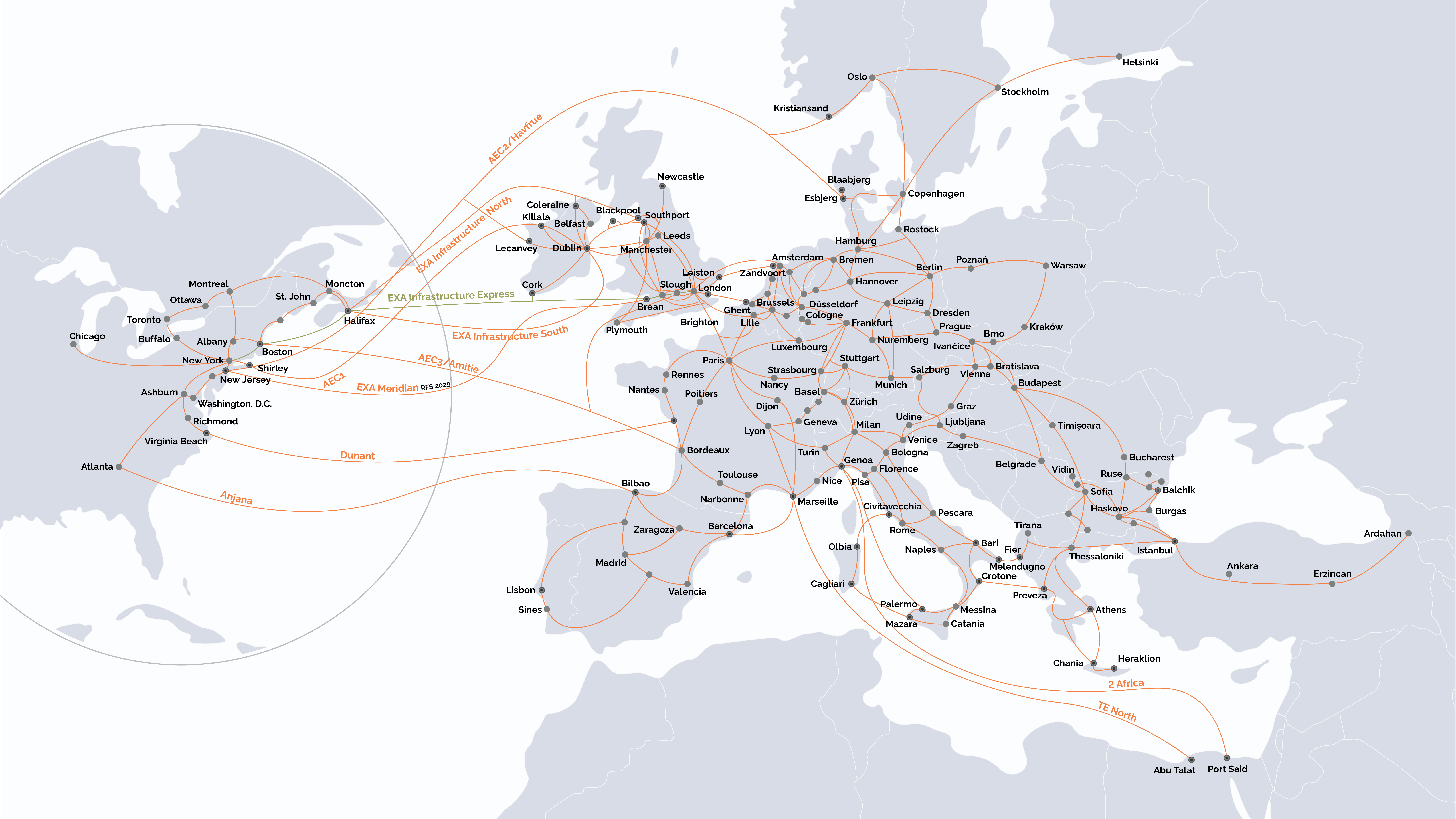
Want to learn more about how network design can support AI growth? Read the full interactive guide from EXA Infrastructure and Ciena: Connectivity: The Key Differentiator Behind Successful AI Cloud Strategies.
Related Articles
2023, the year of the open cable landing station?
Cable landing stations (CLS) are a pivotal aspect to modern infrastructure. As we look ahead to 2023, EXA’s Thomas Fabre, Senior Director of Network Investments looks at the new paradigm and market reaction to open CLS.
EXA Infrastructure: The Gateway to the Mediterranean
Over the last decade, the Mediterranean region has emerged as a strategic hub for global telecommunications, attracting a growing number of subsea cable systems.
Robust, low-latency network infrastructure for Gaming in emerging hubs
EXA Infrastructure is at the heart of this transformation, delivering high-performance, low-latency networks essential for seamless gaming experiences. Read more about how we’re powering the future of gaming.